
 CANASA Member
Are Roller Shutters and Roll-Up Shutters the Same Thing?
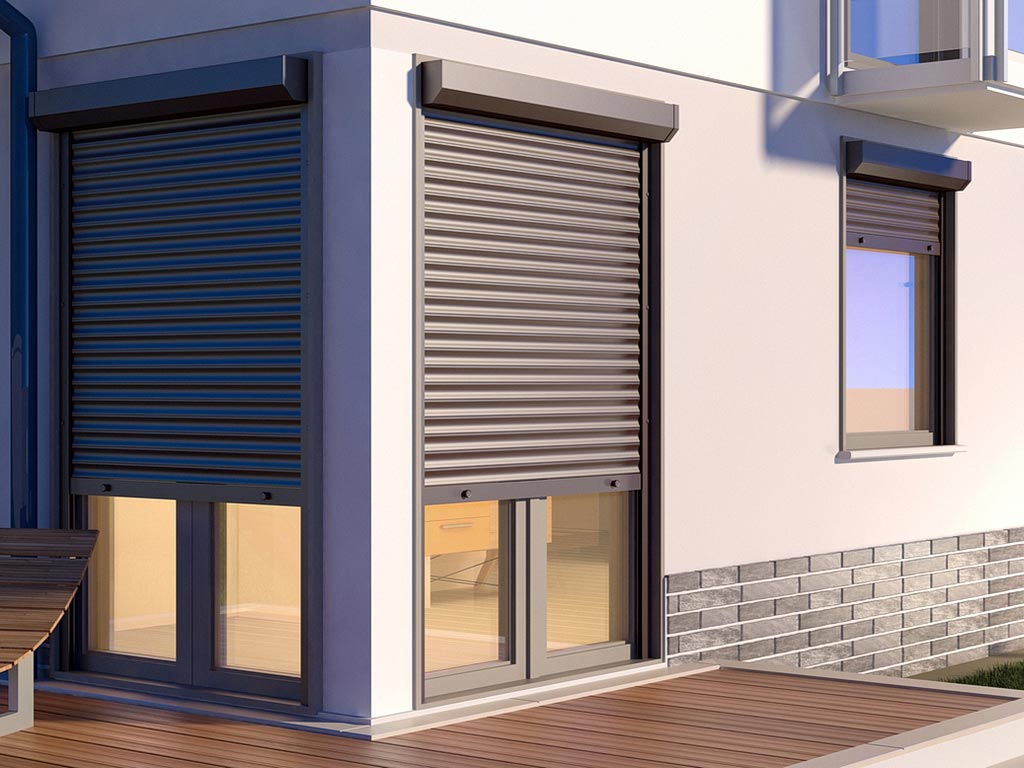
You're pricing exterior shutters for a back door or a row of basement windows, and every site calls them something different: roller shutters, rolling shutters, roll-down shutters, roll-up shutters. They are the same exterior product. A curtain of interlocking aluminum slats coils into a box above the opening and rolls down in side guides to cover it.
The name changes with where you are, not with what you get. Roller shutters is the usual UK and European term; in the US it's mostly rolling or roll-down shutters. Canada borrows from both, so GTA quotes use all of them.
| Name | Where you'll hear it | What it usually refers to |
|---|---|---|
| Roller shutters | UK, Europe, Canadian search results | The product in general, most often on windows and doors |
| Rolling shutters | US manufacturers and catalogues | The same product, often motorized window and patio shutters |
| Roll-down shutters | US residential sites | The same product, named for the way it closes |
| Roll-up shutters / roll-up doors | Canada and the US | The same product; “door” when it covers a garage, shed or storefront |
| Roll shutters / rollshutters | Canadian trade catalogues | The same product, in manufacturer language |
| Roller shutter doors | Commercial and industrial | Larger openings: garages, loading bays, storefronts |
Talius, the Canadian manufacturer whose systems we install, calls them rollshutters and breaks each one into a curtain profile, guide rails, a panel box and an operator. One search trap: “rolling shutter” is also a camera term for the skew in phone video of fast-moving objects, which has nothing to do with windows.
What Is a Roller Shutter, Part by Part?
A roller shutter is six parts: a housing box, a roller tube, a slat curtain, two side guides, a bottom bar and an operator that turns the tube. Each one is a line item you can ask about.
| Part | What it is | What to ask about it |
|---|---|---|
| 1. Housing box (panel box) | An aluminum box mounted above the opening. It holds the roller tube and the rolled-up curtain. | Box size for your opening height |
| 2. Roller tube (barrel or axle) | A steel tube inside the box. The curtain wraps around it as the shutter opens. | Motor inside, or crank gearbox? |
| 3. Slat curtain | Interlocking aluminum slats, hinged at every joint so the curtain can coil. | Which slat profile, and solid or perforated |
| 4. Side guides (guide rails) | Extruded aluminum channels down each side of the opening. The slat ends run inside them. | How they fasten to your wall |
| 5. Bottom bar | A heavier profile along the bottom edge of the curtain that closes against the sill or floor. | Keyed cylinder lock or padlock hasp |
| 6. Operator | What turns the tube: a tubular motor, a detachable crank rod, or a spring on some doors. | Where the switch or crank goes |
Closed, the slats interlock into one continuous aluminum panel and the bottom bar locks into the side guides. Open, the whole curtain is coiled inside the box and the opening is clear. The window or door itself isn't modified: the system mounts to the wall or structural frame around it.
The tube is turned by a tubular motor (we fit Somfy) on a wall switch or remote, by a detachable crank rod in a gearbox beside the opening, or on some doors by a torsion spring that lets you push the bottom bar up by hand. Our guide to roll-up shutter operation types compares them in detail.
Which Roller Shutter Slats Fit Which Opening?
Pick the slat by the opening: a foam-filled slat for most house windows and doors, a single- or double-wall slat where an insulated core isn't needed, and a perforated or grille curtain where you want airflow or a view through. The slat also sets how big the shutter can be.
| Slat type | How it's built | Typical openings |
|---|---|---|
| Standard | Roll-formed aluminum with an insulated core | House windows and doors, counters, cabanas |
| Medium-duty | Roll-formed aluminum with a hard foam core | Residential and commercial windows, doors, storefronts |
| Heavy-duty | Roll-formed aluminum with a hard resin core; our heaviest slat | Pharmacies, electronics and high-value retail, medical storage |
| Single-wall | One thick wall of extruded aluminum, no core | Storefronts, workshops, interior partitions |
| Double-wall | Hollow two-wall extruded aluminum, stiffer than single-wall | Storefronts, workshops, industrial openings |
| Area door | Larger slat with a built-in lock and a self-adjusting rolling carriage | Garages, laneway doors, boathouses, wide commercial bays |
Maximum widths run from 3.35 m (132") for the Standard slat to 4.88 m (192") for Heavy-duty, and up to 6.97 m for an Area door without a panel box. Wider frontages get two or more curtains side by side.
Curtains also come solid or perforated. Solid slats close the opening, hide the glass and what’s inside from view, and block most light. Perforated slats have punched holes for airflow and partial visibility; grille curtains use open or clear links so a display stays visible after hours. Profile drawings and size charts are on our roller shutter specifications page.
Roller Shutters vs Plantation Shutters, Blinds and Garage Doors
A roller shutter is the only product in this group that mounts outside, coils into a box and closes the opening with aluminum. Roller blinds and plantation shutters are interior window coverings, decorative shutters don't move, and a sectional garage door runs on ceiling tracks.
| Product | Inside or outside | How it moves | Typical material | Closes the opening? |
|---|---|---|---|---|
| Roller shutter | Outside | Coils into a box above the opening, runs in side guides | Aluminum slats | Yes, edge to edge |
| Roller blind | Inside | Fabric rolls onto a tube at the top of the window | Fabric or vinyl | Covers the glass from inside only |
| Plantation / California shutters | Inside | Hinged louvred panels swing open; the louvres tilt | Wood, vinyl or composite | Covers the glass from inside only |
| Decorative exterior shutters | Outside | Usually fixed to the wall beside the window | Vinyl, wood or composite | No, they frame the window |
| Sectional garage door | Garage opening | Hinged panels roll back along ceiling tracks | Steel, aluminum, wood or composite | Yes, garage openings only |
Plantation shutters are the most common mix-up. They are interior panels with tilting louvres, fitted inside the window frame; California shutters is another name for the same style. We don't make or install them; if you want louvres you tilt from inside, that's the product to search for.
The garage comparison matters more. A roll-up garage door is a roller shutter sized for a garage: the curtain coils into a box above the opening, so there are no ceiling tracks and no panel swinging out over the driveway. That is why roll-up garage doors are a common choice for garages with low ceilings, car lifts or overhead storage.
Residential vs Commercial Roller Shutters: What Changes
The product is the same; the slat, the size and the operator change with the opening. Homes mostly need window, patio door and garage versions, and businesses need storefront, counter and grille versions. Installed prices are typically:
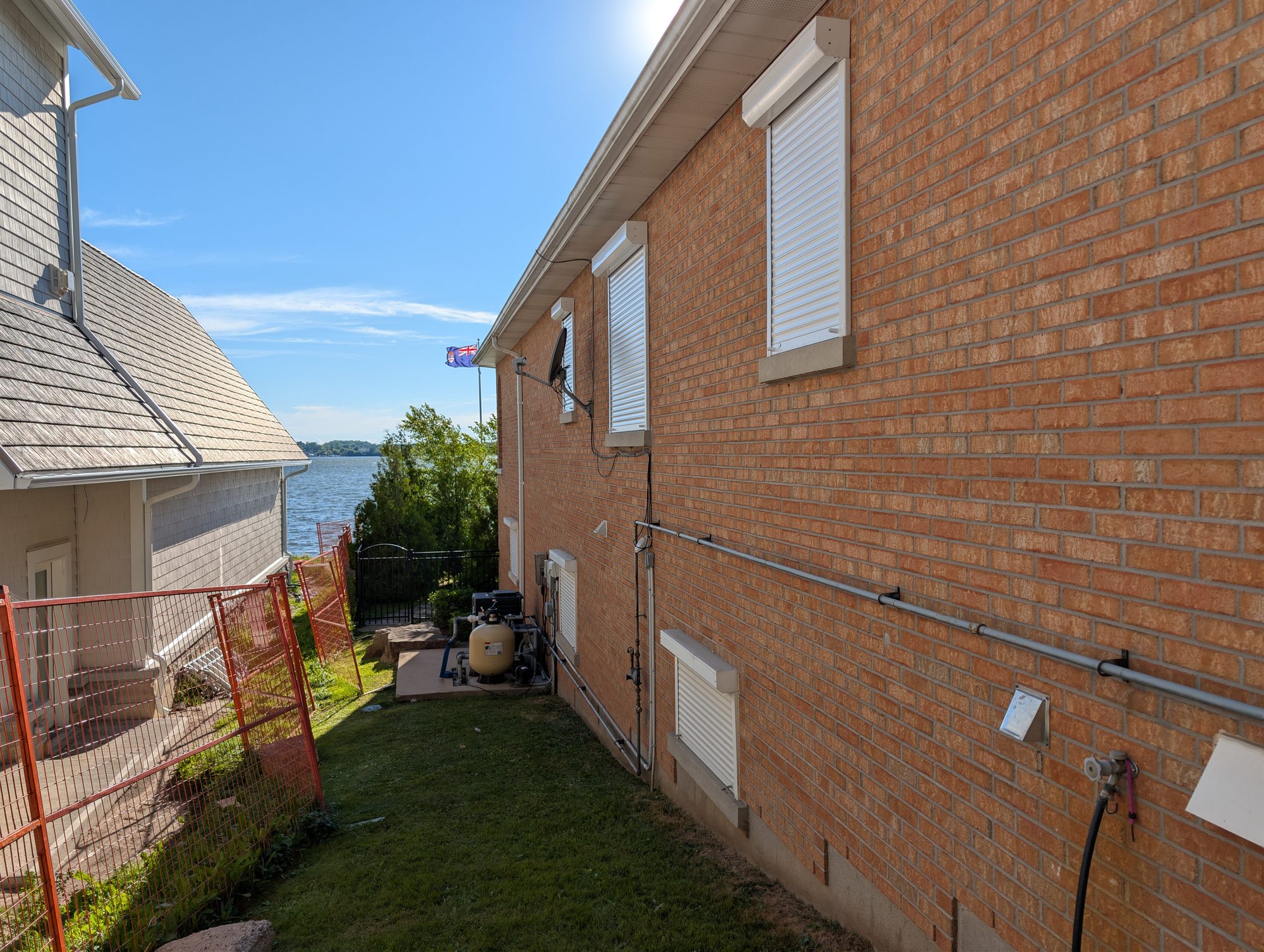
- Window shutters: mounted outside over the glass, typically $800–$1,500 per window. See window roller shutters.
- Patio door shutters: over sliding and French doors, typically from $1,900 per door.
- Roll-up garage doors: single, double and laneway garages, typically $1,500–$3,500 per door.
- Shed and workshop roll-up doors: typically $1,000–$2,500.
- Storefront shutters: solid, perforated or grille curtains over glass frontages and entrances, typically $2,500–$8,000. See storefront shutters.
- Counter shutters: small shutters for bar counters, serveries and reception windows that lock independently of the main openings. Quoted per opening.
- Rolling grilles: open-link aluminum curtains that roll into a housing like a solid shutter, for windows where the display should stay visible. Quoted per opening.

How to Describe the Roller Shutter You Want When Asking for a Quote
Send what the opening is, its width and height, what the wall is made of, whether there's power nearby, and whether you want manual or motorized. With those, an installer can give you a realistic range before anyone visits.
- The opening: window, patio door, garage, shed, storefront or counter, and how many of each.
- Width × height: a rough measurement of each opening is enough. Exact measurements are taken on site before anything is made.
- Mounting surface: brick, stone, stucco, siding or wood framing, and roughly how much wall there is above the opening for the housing box. A taller opening means a larger roll, so a larger box.
- Power: is there an outlet or light fixture near the opening? A motorized shutter needs a standard 110V connection, and we do the wiring as part of the installation.
- Manual or motorized: a crank rod suits windows you close occasionally; a motor suits daily use and large openings.
- Solid or see-through, and colour: white, black, brown, beige and silver are standard, or ask for a custom Benjamin Moore or RAL match.
- Photos: one of each opening from outside, standing back far enough to show the wall above it.
What Happens After You Send It
Every roller shutter is made to one opening, so the written quote comes after a free onsite measurement. Typical lead time is 2–4 weeks from a confirmed order, and most residential installations take a single day. Send us your openings and we reply within 2 hours.